






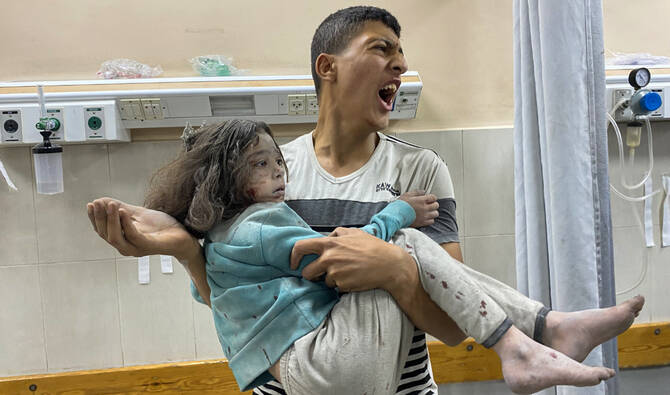
How protracted conflicts from Gaza to DRC are leaving deep scars on children’s lives
Last Updated on July 15, 2025 6:56 pm
LONDON: For children trapped in the world’s conflict zones, 2024 was a year of unprecedented suffering. The UN verified 41,370 grave violations against children — a record-shattering 25 percent increase over the previous year — devastating countless young lives.
From Gaza to the Democratic Republic of the Congo, children are among the most vulnerable victims of war. The consequences go far beyond immediate physical danger, shaping the course of their lives for years to come.
According to the UN Security Council’s June 17 report on children and armed conflict, at least 22,495 were maimed, killed, recruited, or denied life-saving aid — robbed of the safety and innocence that should define childhood.
“The cries of 22,495 innocent children who should be learning to read or play ball, but instead have been forced to learn how to survive gunfire and bombings, should keep all of us awake at night,” Virginia Gamba, special representative of the UN secretary-general for children and armed conflict, said in the report.
“This must serve as a wake-up call. We are at the point of no return.”
The report, the most damning since the UN began collecting data in 1996, also noted a surge in children suffering multiple violations. In 2024, some 3,137 children were subjected to overlapping abuses such as abduction, forced recruitment, and sexual violence — up from 2,684 the year before.
Months before the report’s release, the UN children’s fund, UNICEF, warned of a crisis beyond precedent. In December, the agency declared 2024 the worst year in its history for children caught in war.
“By almost every measure, 2024 has been one of the worst years on record for children in conflict in UNICEF’s history — both in terms of the number of children affected and the level of impact on their lives,” Catherine Russell, the agency’s executive director, said in a statement.
These children are more likely to be malnourished, displaced, or out of school than those in peaceful regions — a reality she insisted “must not be the new normal.”
“We cannot allow a generation of children to become collateral damage to the world’s unchecked wars,” Russell added.
Beyond the physical toll of conflict, psychological wounds are also profound and enduring, often outlasting conflicts themselves.
“What the recent UN report shows is that children caught in conflict zones are facing unimaginable levels of harm,” Dr. Jeeda Alhakim, a specialist counseling psychologist at City St George’s, University of London, told Arab News.
“This kind of violence doesn’t end when the event is over. It stays with them.”
Alhakim explained that prolonged exposure to danger alters a child’s perception of safety and can even reshape their biology. “When the body is constantly in survival mode, it becomes harder to sleep, concentrate, or feel calm,” she said.
Over time, this toxic stress can disrupt brain development, especially in neural regions responsible for memory, decision making, and emotional regulation. “Trauma doesn’t just live in the mind,” Alhakim said. “It becomes embedded in the nervous system.”