





Can Egypt summit turn Gaza’s fragile truce into a foundation for regional peace?
Last Updated on October 14, 2025 7:05 pm
LONDON: Standing before Israeli lawmakers in Jerusalem on Monday, US President Donald Trump declared an end to what he called “a long and painful nightmare.” Twenty surviving hostages had just been released from Gaza after more than two years in captivity.
In return, Israel has begun freeing almost 2,000 Palestinian prisoners as part of the first phase of a US-brokered ceasefire with Hamas.
“For so many families across this land, it has been years since you’ve known a single day of true peace,” Trump told the Knesset. “Not only for Israelis, but also for Palestinians and for many others, the long and painful nightmare is finally over.”
Israeli Prime Minister Benjamin Netanyahu, meanwhile, hailed Trump as “the greatest friend of Israel.”
Yet beyond the theatrics, Trump’s whirlwind visit marked the opening act in a far larger drama.
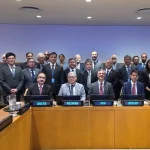
Within hours he was back aboard Air Force One, bound for Egypt’s Sharm El-Sheikh, where more than two dozen heads of state, government and international organizations were gathering for the first high-level summit on Gaza since the ceasefire took hold.
The deal, announced last week, represents the most significant diplomatic breakthrough in the Gaza conflict since the war began with the Hamas-led attack of Oct. 7, 2023, which left 1,200 people dead, most of them civilians, and saw 251 taken hostage.
Israel’s military campaign in Gaza has since killed at least 67,869 people, according to the territory’s health ministry. More than half of the dead are women and children.
Under the terms of the ceasefire, Hamas agreed to release all living hostages and return the bodies of 27 who died in captivity.
Israel, for its part, agreed to free roughly 2,000 Palestinians — 250 of them convicted on security charges — while beginning a partial withdrawal from Gaza.
But as celebrations erupted across Tel Aviv’s Hostages Square and Ramallah’s main thoroughfares, analysts cautioned that the jubilation could prove short-lived. The peace, for now, is merely procedural — the beginning of a process rather than its conclusion.
Hani Nasira, the Egyptian author and academic, said the Sharm El-Sheikh summit was “a high-level international conference convened … to sustain the Gaza ceasefire and finalize an agreement to end the war and start a new chapter for peace and stability in the region.”
He told Arab News: “The gathering follows the signing of the first phase of a ceasefire between Israel and Hamas on Oct. 9. Under the deal, several Israeli hostages and Palestinian prisoners are to be released and humanitarian measures will be implemented.”
Nasira described Egypt’s role as “central” — both as mediator since the war began and now as “regional coordinator” shaping Gaza’s postwar framework.
“Cairo has served as mediator since the crisis began and now leads efforts to shape the postwar framework for Gaza,” he added.
Trump’s partnership with President Abdel Fattah El-Sisi underscores Washington’s renewed reliance on Cairo, which has long acted as the Arab world’s bridge between Israel and the Palestinians.
Together, they are expected to unveil the second stage of Trump’s 20-point Gaza peace plan, announced in late September — a roadmap that envisions a multinational stabilization force and, eventually, a new governing body for Gaza “headed” by Trump himself.
“The US participation is seen as a diplomatic push to secure international commitment to a peace road map that includes a declaration of long-term stability and expanded Arab and global engagement,” said Nasira.
“Trump’s presence and remarks are expected to give the process both political and practical momentum, boosting prospects for translating initial agreements into concrete action.”
Nasira also pointed to the “balanced and pragmatic approach” of Saudi Arabia, which has quietly emerged as one of the most influential players in the post-ceasefire landscape.
“Saudi Arabia has also emerged as a key Arab partner alongside Egypt, contributing financial and humanitarian support while facilitating diplomatic pathways toward regional stability,” he said.
“Over the past several years, the Kingdom has pursued a balanced and pragmatic approach to the Palestinian issue, guided by strategic vision rather than short-term reaction.”
He added: “While Israel’s actions in the region have often been marked by escalation and excessive force, Riyadh has maintained a measured and rational stance, working with partners such as France to build a regional safety net.”
Those efforts, he said, “have helped shape a growing international consensus in favor of a two-state solution and paved the way for the current US-led initiative to end the Gaza conflict.”
At the Sharm El-Sheikh summit, Saudi diplomats are expected to push for regional cooperation and the revival of the 2002 Arab Peace Initiative, which conditions normalization with Israel on the establishment of a Palestinian state.
For Trump, the optics of his Israel visit were both personal and political. The rapturous reception in Jerusalem provided a rare moment of unity for a leader whose presidency has otherwise been defined by polarization.
But the reaction from ordinary Israelis offered a subtler insight into shifting public sentiment.
In a post on X, Saudi political analyst Salman Al-Ansari said: “The booing of Israeli citizens when (US special envoy to the Middle East) Mr. Steve Witkoff mentioned Netanyahu was remarkable.
“Moments later, the same crowd erupted in cheers when he mentioned Donald Trump, even chanting ‘Thank you, Trump!’ repeatedly.
“This contrast should ring alarm bells in the White House. Supporting Netanyahu as an individual is antithetical to supporting Israelis.”
Al-Ansari argued that American policymakers must learn to distinguish between supporting Israel as a nation and aligning uncritically with Netanyahu’s leadership.
“Since AIPAC (American Israel Public Affairs Committee) operatives often label Americans who criticize Netanyahu as antisemitic, perhaps it is time to flip the script and say that supporting Netanyahu is antisemitic,” he said.
The comment reflects a growing unease within parts of the US foreign policy establishment about Netanyahu’s domestic standing and the sustainability of his hard-line policies.
Trump, meanwhile, is determined to frame the ceasefire as a personal triumph — a vindication of his unorthodox diplomacy and a reminder of his ability to command the world stage.
Even some of his Democratic opponents have offered rare praise.
Senator Mark Kelly said the Gaza deal was “his deal,” while Jake Sullivan, President Joe Biden’s former national security adviser, told CNN: “I give credit to President Trump … The question is, can we make sure this sticks as we go forward?”
That question now dominates the Sharm El-Sheikh summit. The ceasefire has stopped the killing for now, but the next stage — disarmament, reconstruction, and governance — will determine whether the truce evolves into a durable peace.
Trump himself seemed aware of the stakes. Israel has “won all that they can through force of arms,” he told the Knesset. It is now time to “translate these victories… into the ultimate prize of peace and prosperity for the Middle East.”
Hamas has so far resisted calls to disarm, demanding international guarantees that Israel will not reoccupy Gaza and that aid will flow freely to rebuild the shattered enclave.
Hamas urges Trump and the mediators of the Gaza deal to “continue monitoring Israel’s conduct and to ensure it does not resume its aggression against our people,” the group’s spokesperson Hazem Qassem said on Monday.
Israeli officials, meanwhile, have avoided committing to a complete withdrawal, citing ongoing security concerns and the risk of renewed rocket attacks.
The Israeli army confirmed Monday that the Red Cross was “on its way to collect the remains of a number of dead hostages” from Gaza — a grim reminder that even as the living return home, the scars of war endure.
Nasira believes the next challenge will be “overcoming internal Palestinian divisions and restoring national consensus” — a prerequisite, he said, for “capitalizing on growing international recognition of the State of Palestine and turning that recognition into tangible progress on the ground.”
He warned that “renewed Arab dialogue is seen not as a political luxury but a necessity for rebuilding trust and restoring unity, particularly as developments surrounding the Palestinian issue accelerate.”
That dialogue, anchored by Egypt and Saudi Arabia, could prove decisive in transforming the current ceasefire into a wider regional settlement.
Al-Ansari sees in this moment both a moral and strategic opportunity for the US president.
“President Trump has a genuine opportunity to make history by prioritizing America’s interests in a way that also benefits all US allies in the Middle East, including Israel, if he takes the lead in ending the cycle of violence once and for all and joins the world in pushing for a two-state solution,” he said.
“He would not only restore America’s global credibility but also unite his MAGA constituency, win praise from both the right and the left in the US, and earn admiration from nearly every nation around the world.
“At that point, history would remember him as the greatest US president of all time, and a Nobel Peace Prize would seem like a downgrade compared to his accomplishments.”
For now, Sharm El-Sheikh is where the momentum lies. Egypt’s Red Sea resort, more accustomed to summits on climate and tourism, has become the new front line of Middle East diplomacy.
Trump’s aides say the president intends to turn the page on decades of failed peace initiatives. But the balance of expectations is delicate. Netanyahu has skipped the summit to mark a religious holiday, leaving his foreign minister to represent Israel.
As Trump and El-Sisi prepare to open the summit, few doubt that the coming days will test whether the “painful nightmare” is truly ending — or merely pausing.