






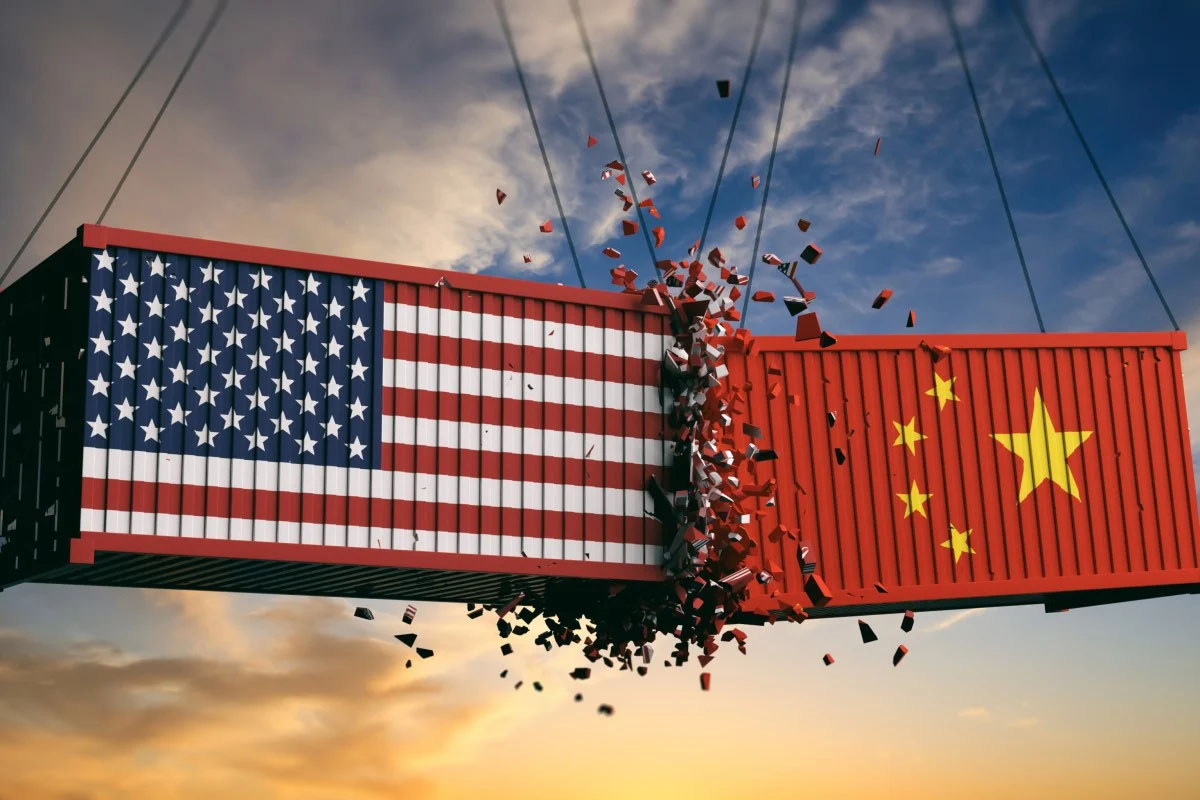
As rising US-China tensions target tech, was the Geneva deal just a flash in the pan?
Last Updated on May 29, 2025 9:12 pm
Ji Siqiin Beijing
Economic tensions between the US and China are rising under the weight of tariffs and spreading into areas where it is harder to reach a consensus – namely, advanced technology – analysts say in the wake of Washington’s reported moves to pause exports of products and technologies related to semiconductor design and jet-engine manufacturing to China.
The US Department of Commerce has told American electronic design automation firms – including Cadence, Synopsys and Siemens EDA – to stop supplying their technology to China, according to a Financial Times report, citing people familiar with the matter.
Meanwhile, Washington has suspended some licences that allowed American companies to sell products and technology to China’s state-owned aerospace manufacturer, Comac, that could be used to develop the home-grown C919 aircraft, The New York Times reported, also citing anonymous sources. The move was made in response to China’s export controls on critical minerals, it said.
“For US-China relations, this poses a threat in terms of undermining the Geneva ceasefire,” said Nick Marro, principal economist for Asia and lead analyst for global trade at the Economist Intelligence Unit, referring to high-stakes bilateral talks that were held earlier this month in Switzerland and resulted in a temporary pause in their tit-for-tat tariff war.
“We are increasingly seeing US-China frictions migrate away from tariffs and into more difficult areas of the economic relationship,” Marro said.
In a setback for US President Donald Trump, a US federal court ruled on Wednesday that he had overstepped his authority in using emergency powers to impose hefty levies on all trading partners, blocking his sweeping “Liberation Day” tariffs – and another set of levies on China, Mexico and Canada amid allegations of their role in the US fentanyl crisis.
Export controls on semiconductor products, equipment and services have increasingly been used in recent years by the US government as leverage to curb China’s progress in chip manufacturing and artificial intelligence.
In 2022, the administration of then-president Joe Biden imposed restrictions on exports to China of some of the most advanced semiconductors, some computer systems, and assemblies containing those chips and equipment used to make those devices, though companies continued supplying compliant products to the market.
The latest export controls under Trump represent a “clear escalation” since the Geneva talks, said Dan Wang, China director with the Eurasia Group.
“The US holds dominance in chip design and is leveraging this market position to contain China’s tech development,” she said. “The decoupling of US-China tech sectors will be prolonged and increasingly complex, regardless of the state of tariff negotiations.”
In the jet-engine domain, China could seek closer ties with partners in other countries. This could include Rolls-Royce, a British aerospace company that is a strong player in the engine space, said Mayur Patel, Asia head at British aviation intelligence firm OAG. But the US, indeed, has an established avionics supply chain, he noted.
And Li Hanming, an independent aviation analyst, said: “China has an engine company, but switching engines without appropriate designs takes years.”
The US could exert greater pressure on partners, including Britain, the European Union and the Middle East, to stop their supply chains from supplying or using sensitive hi-tech products from China, which could lead to a more fragmented and divided global tech supply chain in the future, Wang added.
On Thursday, He Yongqian, spokeswoman for China’s commerce ministry, said China and the US had maintained communication at various levels since the Geneva talks.
“China has repeatedly engaged with the US over its abuse of export-control measures in the semiconductor sector and other practices. China once again urges the US to immediately correct its wrongdoings, cease discriminatory restrictions against China, and jointly uphold the consensus reached during the high-level talks in Geneva,” He said during a press conference.
Yet, the new US export restrictions could also fuel China’s drive to promote domestic substitutions, Wang said, with shares of leading Chinese EDA firms soaring on Thursday.
Meanwhile, China has leverage over the US in the form of export controls on rare earths that are critical for manufacturing in the technology and defence sectors. And these valuable minerals have emerged as increasing bright flashpoint in their economic stand-off.
In a joint statement with the US after their Geneva talks, Beijing agreed to “suspend or remove the non-tariff countermeasures taken against the US since April 2”, and these technically include the licence-based export controls over seven types of medium and heavy rare earths that China imposed on April 4. But China has so far remained ambiguous about its stance on whether the restrictions would be lifted.
Marro noted how Beijing did not appear to be in any hurry to dismantle its licensing regime, despite the Geneva agreement.
“This makes sense,” he explained. “China maintains dominance in this area, and it’s an area where it can continue to pressure the US.
“We’ve heard, anecdotally, that the licensing procedures for some companies remain very challenging and potentially are extending to derivative products – electronics that use certain controlled critical minerals.”